
Article: Not To Pull The Wool Over Your Eyes
Not To Pull The Wool Over Your Eyes
Soooo, today was a very exciting day. And I really needed one, to be honest.
Over the last few months, life behind the scenes has been extra challenging, and a combination of running this business and curveballs in my personal life have been toppling my mental stability (not that it's that stable at the best of times). It feels like I'm definitely being put to the test.
Making decisions on where to put cash for development isn't straightforward, even on a normal day, but when your confidence has taken a good bashing, it makes the decision-making process even harder.
So, when FedEx dropped off a sample package this afternoon, I was ready for another day of disappointment. That sickening feeling in your stomach when another idea isn't quite right, you're not entirely sure what you're looking at, but you're at the point of needing to place an order quickly. Otherwise, you might as well shut up shop and go home. Except that I work from home…
So, imagine my joy when I opened the parcel and these stunning colours and soft, fluffy delights tumbled out.
Thank F**K. It was about bloody time.
Better still, there were beautiful yarn colour books featuring the right blends and all the certifications I needed to create the quality products my customers expect.
I won't lie, knitwear has been a new learning curve, but I was ready to take on a challenge. I wear cardigans a lot, so it seemed like the obvious next step. Back in 2021, I did a short course on sustainable fabrics at the University of the Arts London (UAL), and week one happened to be all about wool. So I already knew the importance of responsibly sourced wool and animal fibres, and making sure the yarns we use meet the right standards. It's not just about how beautifully soft something feels, but where those fibres have come from in the first place. So, over 4 years later our Joni cardigan was finally born.
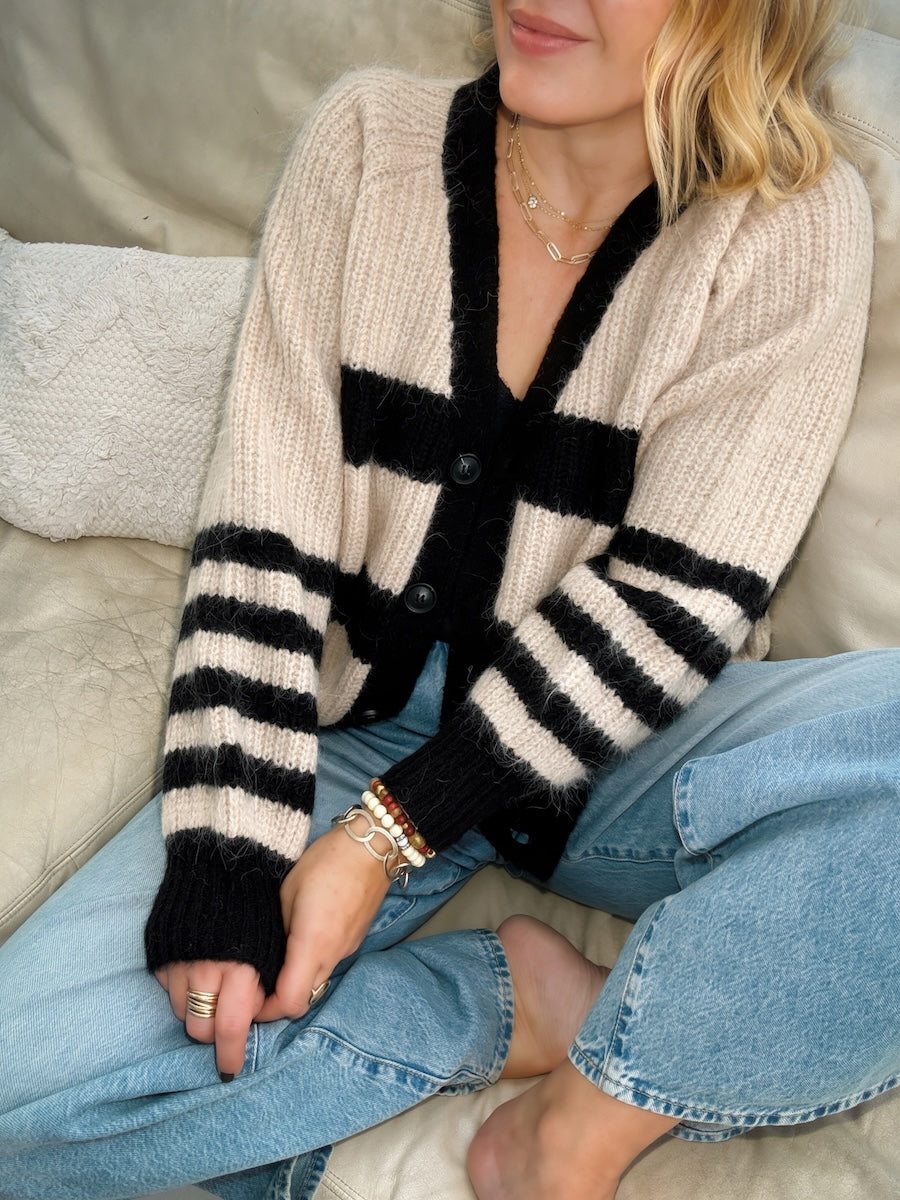
 This soft wide stripe cardigan proved it was exactly the right time to start knitwear, because the first drop sold out fast. Unfortunately, I didn't have time to organise a second drop before summer, so had to wait it out until now. Thankfully, the brown version is now back online alongside a new colour-way.
While I'm on the subject, I think it’s important to explain something quite important about the yarn blend we're using for this particular style. Our Joni cardigan is made from 50% alpaca, 15% wool and 35% nylon (also known as polyamide). Obviously, we'd all prefer 100% natural yarns, but it isn't that straightforward. Different natural fibres have different properties, and sometimes blending them with other fibres actually makes a better garment.

Let me explain it in the best way I can.
ALPACA is the hero of our Joni cardigan. It brings superior warmth because the fibres trap air, insulating without adding heavy bulk. It creates that beautiful soft fuzz that gives it a high-end brushed look. Alpaca also contains no lanolin, making it a lovely option for people who find sheep's wool irritating.
Unfortunately, it lacks elasticity, so over time it can lose its shape unless it's blended with something else.
Enter WOOL, which acts like a spring. It has natural elasticity, helping collars, cuffs and hems keep their shape rather than stretching out permanently. Sheep's wool works perfectly well alone, but it's also a friendly companion for its softer pal, alpaca. Like a stronger big brother giving a younger sibling a helping hand.
Then there's NYLON, also known as polyamide, which isn't the same as polyester.
Nylon is the protector. It adds strength and durability to the delicate natural fibres, helping the cardigan cope with everyday wear. Although I still recommend washing by hand in cold water and absolutely NO tumble drying!

Think back to the history of stockings. For centuries, fine stockings were made from luxury silk. Beautiful, but notoriously fragile. The invention of nylon changed fashion forever, offering a stronger, more practical alternative that could withstand everyday wear.
And that's what we're looking for here. Something beautiful that can actually be worn.
But hang on, I have an even better analogy. Are you ready for this one?
I'm sure you're all familiar with the story of the Three Little Pigs. The huffing and puffing and blowing the house down. Well, imagine this.
If the first two little pigs had just blended their straw and sticks with a few bricks, the Big Bad Wolf wouldn't have stood a chance.

That's the philosophy behind this cardigan.
The Straw (50% Alpaca): Soft, light and fluffy, giving us that beautiful cloud-like warmth. But without much natural elasticity, it needs a little help keeping its shape.
The Sticks (15% Wool): The framework. Adding spring and structure so the cardigan doesn't end up looking like it's had a particularly difficult day.
The Bricks (35% Nylon): The reinforcement. Adding strength and helping the softer fibres cope with the demands of actually being worn.
I know, I know. Genius explanation (pats herself on the back).
But I already know what you're thinking. Isn't polyamide basically the same as polyester or acrylic?
Well, no. They're all synthetic fibres, but they're not identical, and they don't necessarily serve the same purpose in a garment.
Acrylic is often used as a cheaper alternative to wool, while polyester can be used for all sorts of reasons, including cost, durability and easy care. Nylon is particularly valued for its strength and resistance to abrasion.
That doesn't mean every garment containing nylon is great or that anything containing acrylic or polyester is automatically rubbish. It's about understanding why a particular fibre has been used, how much of it is there and what the finished garment actually feels and performs like.
I've read up on this so much that my brain hurts, but at least I feel I can confidently explain why we've chosen this particular blend.
As a general rule of thumb, I like to look for a good proportion of natural fibres in quality knitwear, ideally above 60%, to get the warmth, breathability and lovely feel that I'm looking for. Our Joni cardigan contains 65% natural fibres for that cloud-like luxury feel, balanced with 35% nylon to help hold everything together and improve its durability (remember, that Alpaca is a bit of a lightweight and needs some sibling love).
So, if you see a lovely jumper advertised as a WOOL JUMPER, look at how much wool it actually contains. You might be surprised.
And that's really my point. It's not just about whether something contains synthetic fibres. It's about what those fibres are doing there in the first place - structure or replacement. Big difference.
If you're still here Zzzzzzz…
The good news is that the new SS27 samples were absolute stunners (god I needed that boost).
And this brings me back to the slightly less glamorous side of running a small fashion business. Investment and cashflow.
Developing a collection for a season that's still months away means committing money long before you have any idea how it's going to sell. And when you're a small business, there isn't an endless pot of cash sitting around waiting to be spent. Every decision matters, and getting one wrong can be expensive.
I've put the money I've made from the Joni cardigan straight back into developing more knitwear for Spring/Summer 2027. That's how it works here. One successful product helps fund the next, and you cross your fingers that you've made the right decisions.
Which is why opening that parcel today felt like such a relief. After months of research, sampling, questioning myself and wondering whether I should be spending the money at all, something finally immediately felt right.
And for once, I closed the parcel feeling rather pleased with myself (and silently prayed that my gut wasn't playing up)!


Leave a comment
This site is protected by hCaptcha and the hCaptcha Privacy Policy and Terms of Service apply.